
The Silent Performance Failure™: Why Post-Deployment AI Governance is the Next Great Healthcare Challenge
The healthcare industry has crossed a digital Rubicon. We have moved from asking "if" we should use AI to "how many" models we can deploy. But a dangerous gap has emerged: we are scaling risk faster than we are scaling accountability.
Recent industry data confirms a systemic vulnerability: while hundreds of AI-enabled medical devices are hitting the market, only a tiny fraction (roughly 9%) include rigorous plans for post-market surveillance.
At SmartSigma AI, we’ve identified this as Silent Performance Failure™—a state where AI systems continue to operate while their accuracy, data integrity, or clinical utility has quietly eroded.
The Anatomy of a "Silent Failure"
Unlike traditional medical hardware, AI doesn't "break" with a loud error message. It fails through three specific, quiet mechanisms:
1. Silent Degradation
This is the "calibration drift." A model that was 95% accurate at launch may quietly slip over several months. Because no alert fires, clinicians continue to act on outputs that have diverged from their validated baseline.
2. Data Integrity Failure
AI is only as reliable as the data it consumes. When a patient population shifts—perhaps due to a new demographic or a change in hospital coding—the model begins to operate on data it wasn't trained for. These errors aren't random; they are directional, creating hidden patterns of bias or inaccuracy.
3. Clinical Interface Failure
This is the breakdown at the "last mile." Even a perfect model fails if the human element is broken. When clinicians suffer from alert fatigue or cannot explain an AI’s recommendation, they stop trusting the system. This creates a massive liability exposure that exists independently of the model’s technical performance.
Where Does Your Organization Stand?
To help health systems navigate this, we developed the Silent Performance Failure™ Maturity Model. It allows organizations to self-assess their current posture:
Level 1: Unaware – No central inventory of AI, no baselines, and no clear accountability.
Level 2: Reactive – Monitoring is sporadic and usually triggered by a negative event or a vendor update.
Level 3: Structured – Defined protocols and board-level reporting are in place.
Level 4: Adaptive – Integration of agentic AI governance and behavioral monitoring.
Level 5: Governing – The gold standard. Real-time governance where every drift is detected and every output is accountable.
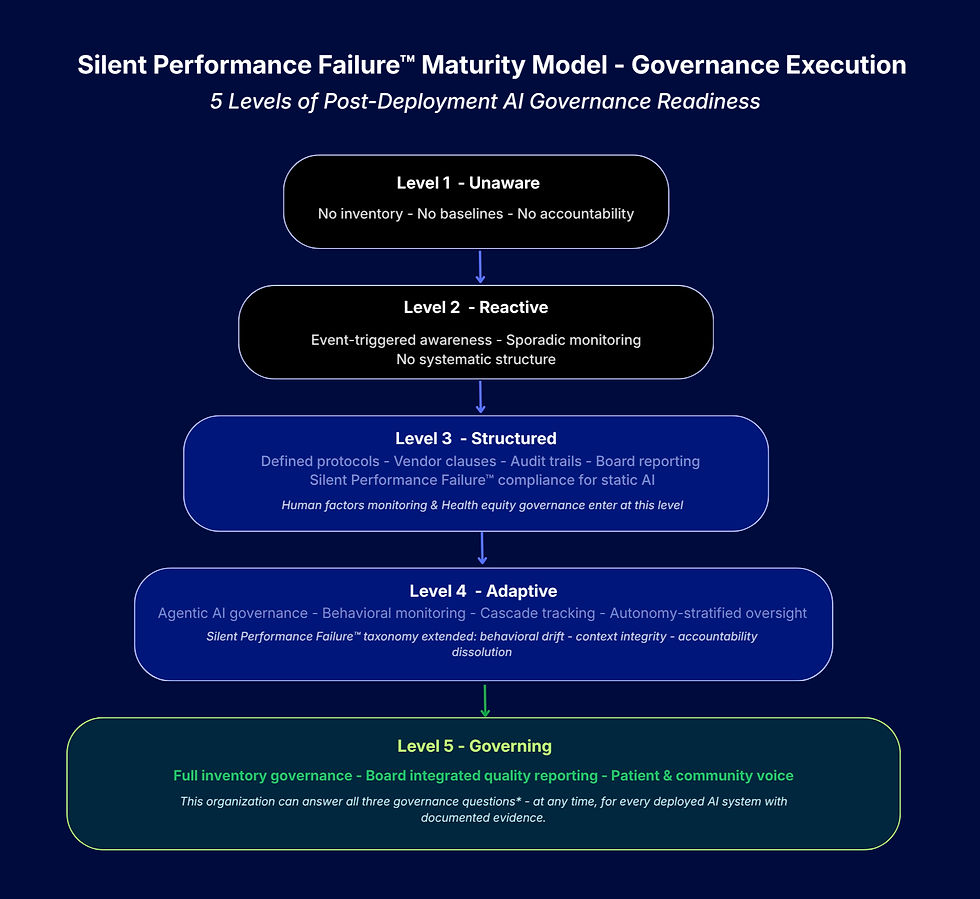
Silent Performance Failure™ Maturity Model - Governance Execution
The Solution: The SmartSigma AI TRI-LEVEL Framework
Moving from "Unaware" to "Governing" requires a structured system. Our TRI-LEVEL Framework bridges the gap through three layers of engagement:
Layer 1: The Foundation – Using a threat taxonomy to identify where silent failures are most likely to occur.
Layer 2: Governance Execution – Activating protocols across detection, data governance, and vendor contracts.
Layer 3: Complete Governance Engagement – Sustained, top-down oversight that moves AI from an "IT project" to a board-level priority.
The Three Questions for the Board
The era of "set it and forget it" AI is over. Regulators and boards are beginning to ask three high-stakes questions:
Is our deployed AI still performing as validated?
Do we know exactly when it stopped?
Do we have the documentation to prove we are governing it?
Organizations that can answer "YES" with documented evidence are the ones that will lead the next decade of healthcare innovation. Those that cannot are merely waiting for a silent failure to become a public crisis.
Don't wait for something to go wrong.
To begin your journey toward Level 5 Governance, reach out for a confidential governance conversation.
Email: admin@smartsigmaai.com | Web: SmartSigmaAI.com


